Should You Get an X-Ray After an Ankle Injury? The Ottawa Ankle Rules Explained

The ankle is one of the most commonly injured joints in the human body.
It carries our entire body weight, and when it’s not stable—whether from injury or chronic weakness—it becomes a frequent site of sprains, pain, and long-term dysfunction.
The Problem With Repeated Ankle Sprains
Repetitive ankle sprains—especially in younger athletes—can lead to permanent ankle laxity.
This increases the risk of more sprains, joint instability, and even early arthritis as you age.
In fact, most high school and college athletes I treat in the clinic, regardless of their diagnosis, often have a history of ankle sprains and signs of ligament laxity.
So, When Is an X-Ray Actually Needed?
One of the most common questions I get is:
“How do I know if I fractured my ankle or just sprained it again?”
The answer:
✅ The Ottawa Ankle Rules
This clinical tool helps determine if an X-ray is necessary after ankle trauma.
It’s quick, accurate, and backed by years of research.
The 5-Part Ottawa Ankle Rules Test

If the patient has any pain in the ankle or foot after an injury, perform the following checks:
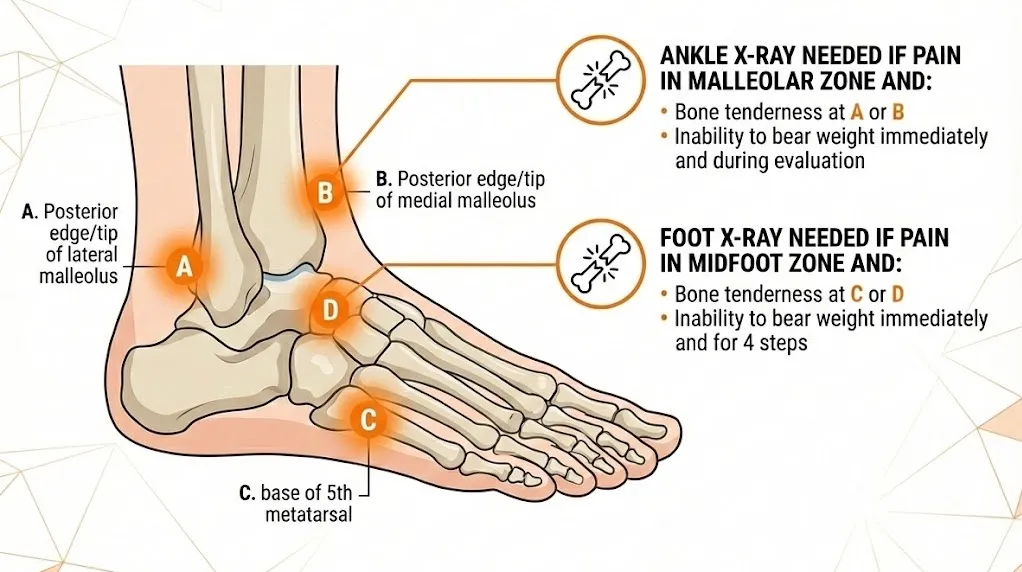
Bony tenderness along the distal 6 cm of the posterior edge of the fibula or tip of the lateral malleolus
Bony tenderness along the distal 6 cm of the posterior edge of the tibia or tip of the medial malleolus
Bony tenderness at the base of the 5th metatarsal
Bony tenderness at the navicular bone
Inability to bear weight both immediately after injury and for four steps during initial evaluation
When Is an X-Ray Warranted?
An Ankle X-ray is needed if:
There’s pain in the malleolar zone AND
Any of the following are present:
Tenderness along the back (posterior) edge of the tibia or medial malleolus
Tenderness along the back edge of the fibula or lateral malleolus
Inability to bear weight right after the injury and during evaluation
A Foot X-ray is needed if:
There’s pain in the midfoot zone AND
Any of the following:
Tenderness at the base of the 5th metatarsal
Tenderness at the navicular bone
Inability to bear weight immediately and in an hour for four steps
💡 Remember: tenderness on the front (anterior) of the malleolus may simply indicate a ligament sprain—commonly the anterior talofibular ligament.
The Evidence
According to a systematic review published in the BMJ, the Ottawa Ankle Rules have a sensitivity of 96–100%.
That means if there is a fracture, this test is very likely to catch it.
Citation:
Bachmann LM, Kolb E, Koller MT, Steurer J, ter Riet G.
Accuracy of Ottawa ankle rules to exclude fractures of the ankle and mid-foot: Systematic review.
BMJ 2003;326:417–23.
🔗 Read Full Study
When in Doubt, Get Checked Out
If you're experiencing tenderness at any of the test locations—or can’t put weight on your foot—it’s best to consult a physician and get an X-ray.
That said, if you don’t meet any of the Ottawa criteria, it’s unlikely that you have a fracture.
Final Takeaway
Understanding the Ottawa Ankle Rules can help you make more informed decisions after a sprain or trauma.
Whether you're an athlete, coach, or weekend warrior, this tool can help you avoid unnecessary X-rays—while making sure serious injuries aren't missed.
Questions? Concerns?
If you're unsure whether your ankle needs rehab, imaging, or rest, we're here to help.If any of these exercises feel too difficult or painful, don’t push through alone.
📧 Email us today to get expert advice or book an evaluation.